How to Create a Châteaucore Gallery Wall with Printable Art (for Renters & Small Apartments)
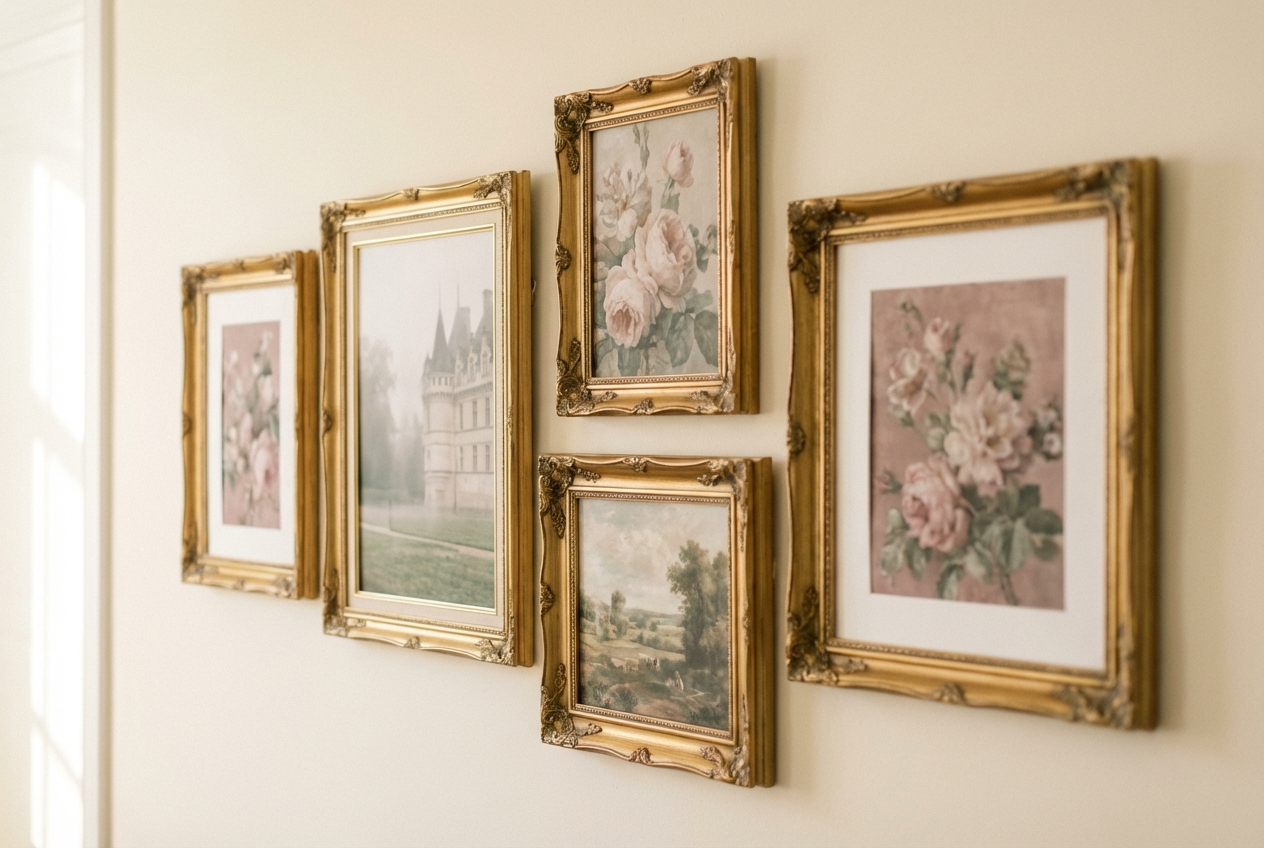
You've scrolled through Pinterest and Instagram, saving dreamy images of French château interiors—ornate mirrors, vintage florals, moody landscapes. Your apartment walls? Bare, boring, or covered in random art that doesn't quite work together.
Here's the good news: you don't need a sprawling French estate (or even a landlord's permission to drill holes) to create that romantic, old-world aesthetic. With printable wall art and a simple plan, you can build a Châteaucore gallery wall that transforms your rental without damaging walls or breaking the bank.
By the end of this guide, you'll know:
- Which wall to use and what Châteaucore "mood" fits your space
- Which gallery wall layout to choose (with exact print quantities and sizes)
- How to curate images that work together
- How to print your art affordably
- How to hang everything without damaging your walls
Rather skip the planning? If you'd prefer a ready-made solution, I've designed a Châteaucore gallery wall bundle that follows this exact plan—curated prints, coordinated palette, optimized sizes for common layouts. → Get the Ready-Made Bundle
Step 1: Choose Your Wall and Your Version of Châteaucore
Pick Your Wall
Not every wall is right for a gallery. Look for:
- Above the sofa: The most popular spot. You have a natural anchor point and can build upward.
- Above the bed: Creates a dramatic focal point. Keep pieces secure (no heavy glass frames directly over your head).
- Above a desk or console: Smaller walls work well here, especially slim vertical layouts.
- Hallways: Often overlooked, but a narrow strip of coordinated prints can make a huge impact.
Stand in front of your wall and hold your arms out. The "sweet spot" for your gallery center should be roughly at eye level (about 57-60 inches from the floor).
Define Your Châteaucore Mood
Châteaucore isn't one look—it's a spectrum. Before you start collecting prints, decide which flavor speaks to you:
Soft Romantic Countryside- Pastel landscapes, rolling lavender fields, morning mist over vineyards
- Soft florals (peonies, roses, hydrangeas)
- Light-filled château interiors, weathered shutters
- Palette: creams, dusty pinks, sage greens, powder blues
- Darker portraits with gilded frames, still lifes with dramatic lighting
- Deep greens, burgundies, navy, and gold accents
- Ornate interiors, velvet textures, candlelit scenes
- Palette: forest green, wine red, midnight blue, antique gold
- Storybook castles, enchanted forests, deer in misty glades
- Dreamy, slightly surreal imagery
- Softer contrast, almost watercolor-like tones
- Palette: soft grays, blush, lavender, mossy green
Step 2: Pick a Simple Gallery Wall Layout
Don't overthink this. The most successful gallery walls follow predictable patterns. Here are three renter-friendly layouts that work in small spaces:
Layout A: Balanced 6-Piece Grid
Best for: Above a sofa or bed (roughly 48-60 inches of wall width)
What you need:- 2 larger prints: 12×16 inches each
- 4 medium prints: 8×10 inches each
[  8×10  ] [  12×16  ] [  8×10  ]
[  8×10  ] [  12×16  ] [  8×10  ]
Place the two larger prints in the center column, flanked by smaller prints. This creates symmetry without feeling rigid. Space frames about 2 inches apart.
Layout B: Asymmetrical Salon Cluster
Best for: Above a desk, console table, or smaller wall sections (36-48 inches wide)
What you need:- 1 large "hero" print: 16×20 inches
- 3-5 smaller prints: mix of 5×7 and 8×10 inches
The key: keep gaps consistent (1.5-2 inches) even if placement feels random.
Layout C: Slim Hallway Strip
Best for: Narrow hallways, vertical wall spaces beside doorways
What you need:- 3 vertical prints: 8×12 inches each (or 11×14)
Step 3: Curate Your Châteaucore Images
Now comes the fun part: picking the actual images. But this is also where most people go wrong—they grab every pretty print they see and end up with a jumbled mess.
The Hero + Supporting Cast Formula
Think of your gallery like a movie cast:
- 1-2 Hero pieces: Large, detailed images that anchor the wall. These should be your most striking pieces—a château exterior, an ornate interior, a dramatic floral still life.
- 3-5 Supporting pieces: Simpler images that complement the heroes without competing. Smaller florals, subtle landscapes, architectural details, or muted portraits.
Image Types That Work
For a cohesive Châteaucore gallery, draw from these categories:
- Architecture: Ivy-covered châteaux, stone bridges, garden gates, ornate doorways
- Florals: Vintage botanical prints, painterly roses, garden scenes
- Landscapes: Rolling countryside, misty forests, vineyards, pastoral fields
- Interiors: Gilded mirrors, antique furniture, candlelit rooms
- Portraits: Classical paintings, soft-focus figures, silhouettes
- Still lifes: Fruit bowls, wine bottles, old books, candles
Keep Your Palette Tight
This is the secret to a professional-looking gallery: limit your color palette.
Pick 3-4 main colors that appear across most of your prints. For example:
- Soft romantic: cream, dusty rose, sage green, pale blue
- Moody salon: deep green, burgundy, gold, warm brown
If one print has a wildly different color (bright orange in a sea of muted greens), it will stick out. Either find a replacement or use it as a small supporting piece where it won't dominate.
Avoid These Mistakes
- Mixing eras too wildly: A hyper-modern geometric print next to a Renaissance portrait feels jarring.
- Too many busy images: If every print is highly detailed, nothing stands out. Balance detailed heroes with simpler supporting pieces.
- Ignoring frame style: Even with matching prints, mismatched frame colors/styles can break the illusion. Stick to 1-2 frame finishes (e.g., gold and natural wood, or all black).
Step 4: Printable Art Logistics (File Sizes & Printing)
One of the best things about printable art: you buy once, print at any size, and reuse forever. But there are a few things to understand before you hit "print."
Why Digital Downloads Work for Gallery Walls
- Instant access: No waiting for shipping
- Flexible sizing: Print at 5×7 for a small cluster or 16×20 for a statement piece (if the file resolution supports it)
- Cost-effective: A single digital file often costs $3-8 vs. $30-80 for a shipped physical print
- Reprints are free: Move to a new apartment? Print again.
Understanding Aspect Ratios
Aspect ratio is the relationship between width and height. Common ratios for wall art:
| Ratio | Common Frame Sizes |
|---|---|
| 2:3 | 4×6, 8×12, 12×18, 16×24 |
| 3:4 | 6×8, 9×12, 12×16, 18×24 |
| 4:5 | 8×10, 16×20, 24×30 |
| A-series (ISO) | A4, A3, A2 |
Most Etsy printable art listings specify which sizes are included or which ratios the file supports.
How to Print Your Art
Option 1: Print at home- Best for: Smaller prints (up to 8.5×11), quick tests
- Requirements: Decent inkjet printer, matte or semi-gloss photo paper
- Tip: Print a small test first to check colors before committing to large paper
- Best for: Larger prints (11×14 and up), when you don't have a photo printer
- Where: Office supply stores, photo labs, pharmacies with photo departments
- Tip: Bring your file on a USB drive and ask for matte or luster finish (not glossy—it glares)
- Best for: Bulk orders, specialty paper, larger sizes
- How it works: Upload your file, choose paper/size, prints ship to you
- Tip: Order well in advance—shipping can take 5-10 days
Pre-Print Checklist
Before printing, verify:
- File resolution is at least 300 DPI at your target print size
- Aspect ratio matches your frame
- Color profile is sRGB (most print services expect this)
- You've done a small test print to check colors
- Paper type: matte or semi-gloss (avoid high-gloss for vintage aesthetic)
Step 5: Hang It Like a Renter
You've got your prints. Frames are ready. Now: how do you get this on the wall without losing your security deposit?
Renter-Safe Hanging Methods
Command Strips (Best for most situations)- Weight capacity: up to 16 lbs per strip set
- Works on: Painted walls, wood, tile, metal
- Pro tip: Use more strips than you think you need. One set per frame is often not enough for frames over 11×14.
- Best for: Unframed prints, mini-print clusters, lightweight paper
- Creates a casual, almost scrapbook aesthetic
- Easy to reposition without damage
- Mount a narrow shelf with Command strips, then lean frames against the wall
- Great if you like to swap prints frequently
- No holes in the wall at all
- Prop larger framed prints on a dresser, mantel, or bookshelf
- Pairs well with smaller hung pieces above
Spacing and Placement Guidelines
- Gap between frames: 1.5-2 inches is standard. Tighter gaps (1 inch) feel more "collected salon"; wider gaps feel more modern.
- Center of arrangement: Should be at eye level (57-60 inches from floor). If hanging above furniture, leave 6-8 inches between the top of the sofa/bed and the bottom of the lowest frame.
- Use paper templates first: Cut paper to frame sizes, tape to wall, step back and evaluate before hanging actual frames. Much easier to adjust.
Quick Do's and Don'ts
Do:- Anchor your arrangement to furniture below (don't float a gallery high on an empty wall)
- Keep heavier/larger pieces lower or centered
- Test your layout with paper cutouts first
- Hang a single tiny frame on a large empty wall (it looks lost)
- Place frames too high—viewers shouldn't crane their necks
- Mix too many frame colors in a small arrangement
FAQ
Can I mix black-and-white prints with color in a Châteaucore gallery?
Yes, but do it intentionally. If you want a cohesive look, keep B&W pieces grouped together or use them as small accent pieces among predominantly warm-toned color images. Randomly scattering B&W and color makes the wall feel chaotic.
What if my printer isn't great?
Don't risk it on large prints. Home printers often struggle with color accuracy and can't handle paper larger than 8.5×11. For anything bigger than a small accent piece, use a local print shop or online service. It's worth the few extra dollars.
How many pieces is too many for a small room?
For a typical apartment living room, 5-8 pieces is plenty for one gallery wall. Going beyond that risks overwhelming the space. A hallway might handle only 3-4. When in doubt, start smaller—you can always add more later.
Can I reuse these prints if I move apartments?
Absolutely. That's one of the biggest advantages of printable art. Keep your digital files organized (cloud storage is your friend). When you move, you might want different sizes for your new walls—just reprint.
Do I need to mat my prints?
Not required, but mats add a polished, intentional look. White or off-white mats work well for most Châteaucore aesthetics. Pre-cut mats are inexpensive at craft stores and frame shops.
What's the fastest way to get this done without hunting for individual prints?
If matching palettes, sizes, and styles sounds overwhelming, a curated bundle saves hours of searching. I've put together a Châteaucore Gallery Wall Printable Set that includes coordinated prints optimized for the layouts in this guide—ready to download, print, and hang.
Ready to Create Your Châteaucore Gallery Wall?
You now have everything you need:
- A wall picked out
- A Châteaucore mood chosen
- A layout with specific print sizes
- Image curation guidelines
- Printing know-how
- Renter-safe hanging techniques
The only thing left is to gather your prints and start building.
Two paths forward:- DIY your collection: Use this guide to hunt for individual printable art pieces on Etsy, design marketplaces, or vintage print archives. Take your time curating.
- Grab a ready-made bundle: If you want to skip the hunting and start hanging this weekend, check out the Châteaucore Gallery Wall Printable Bundle—6 coordinated prints designed for the layouts above, optimized sizes included, cohesive palette ready to go.
Either way, your walls are about to look a lot more like that Pinterest board.